UTokyo × DENSO Dialogue: The More We Move, the More Society Thrives
University of Tokyo Komaba Research Campus Open House 2026 Talk Event
The push toward diversified mobility and the demand for carbon neutrality mark a major turning point for the mobility industry.
In April 2026, the University of Tokyo (UTokyo) and DENSO launched the DENSO-UTokyo Lab, a ten-year industry-academia co-creation project. Its guiding vision: "The More We Move, the More Society Thrives." The idea is a future in which the more we drive, the more energy accumulates, the more data builds up, and the more happiness grows for everyone. Both partners see dynamic wireless power transfer (DWPT) — a system that supplies power wirelessly to vehicles while they drive — as the key to realizing that future.
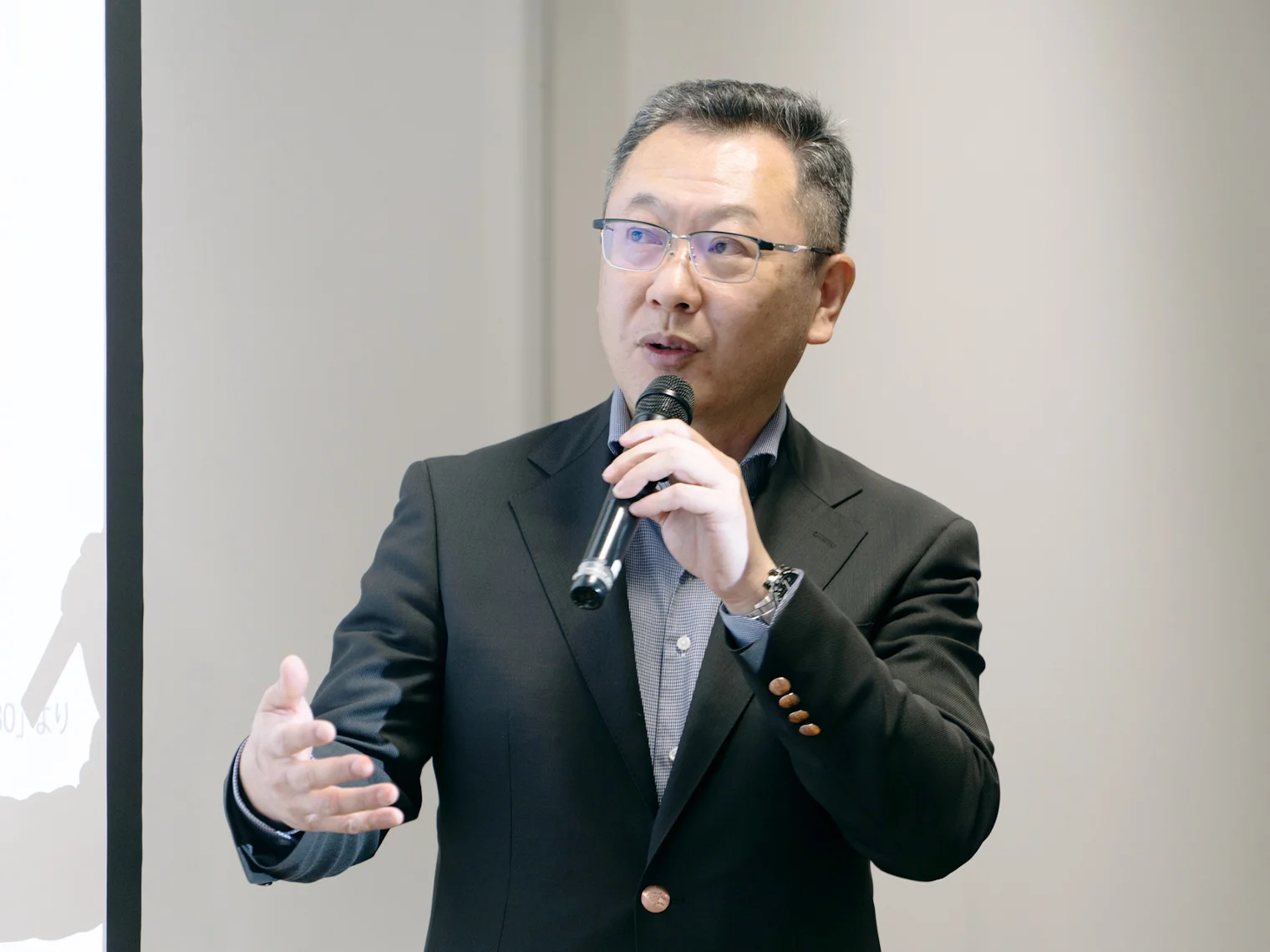
To mark the Lab's launch, a dialogue event held in June 2026 brought together Yudai Honma, a specialist in social systems engineering, Associate Professor at the University of Tokyo's Institute of Industrial Science and the Lab's director on the university side, and Shinichi Yatsuzuka, Senior Director at DENSO and the Lab's director on the company side.
Moderated by Kazuoki Matsugatani, Senior Adviser at DENSO, the conversation ranged from DWPT to how mobility, energy, data, and talent development connect with one another, and how mobility can expand the possibilities open to society. Graphic creator Moe Harunaka captured the dialogue live in a graphic recording, sketching it out in real time in pictures and words.
Contents of this article
The Goal of Industry-Academia Co-Creation: From Solving Individual Problems to Optimizing Society as a Whole
The dialogue opened with Honma laying out the vision behind the co-creation lab. Behind it lies what he calls the "wide-ranging structural transformation" now underway in the mobility industry. Electrification and the charging infrastructure that comes with it, the rollout of autonomous driving and the AI and computing resources it requires — these are converging with broader social demands and challenges: carbon neutrality, energy constraints, an aging, shrinking population, and the goal of zero traffic fatalities.
"Rather than solving problems one by one, I think it's important that society treats things as a single, integrated whole — staying conscious of how everything connects, and optimizing in coordination with all the stakeholders involved. It's about reframing mobility as one integrated social system, and that's the perspective DENSO and I have been discussing together." — Honma
The University of Tokyo brings cross-disciplinary academic knowledge in mathematical optimization, urban design, autonomous-vehicle control, safety-assurance theory, and semiconductor design. DENSO brings manufacturing capability, electrification and intelligence technologies, in-vehicle semiconductors, software, and the ability to put all of it into practice.
Together, the two partners aim to carry projects all the way from research through demonstration, institutional design, social implementation, and talent development — an organization-to-organization industry-academia partnership formalized through an agreement running from April 1, 2026 through March 31, 2036. The University of Tokyo's Institute of Industrial Science serves as the core base on the university side, making this the university's first long-term, comprehensive, organization-to-organization partnership in the mobility field.
"Until now, movement and mobility have carried a somewhat negative image — something that consumes energy, takes time, and tires you out. At the DENSO-UTokyo Lab, we want to turn that around and make mobility a source of value instead: energy that fills up the more you drive, data that builds up the more you drive and can be put to work solving social challenges and creating new value, and, above all, greater well-being and satisfaction for all of us. We want to think of mobility as a wellspring of social value." — Honma
Dynamic Wireless Power Transfer: The Foundation for a New Kind of Value
Dynamic wireless power transfer (DWPT) sits at the foundation of this shift in how mobility creates value. Conventional electric vehicles (EVs) typically charge by plugging into a connector while parked. DWPT instead sends power wirelessly from coils embedded in the road to a receiving coil mounted on the vehicle, allowing it to charge even while driving at highway speeds.
Honma has studied DWPT from the standpoint of where and how much of it needs to be installed for society to keep moving smoothly, and for the economics to pay off. His calculations for optimal placement on expressways suggest the system becomes sufficiently cost-effective once EV adoption reaches around 10% for logistics vehicles and 20–30% for private cars. The key, he says, is finding the right amount of DWPT infrastructure for a "best mix" in which DWPT covers roughly 95% of demand and charging stations cover the remaining 5%.
For city streets, using a traffic simulation that reproduces the behavior of individual vehicles, Honma's team modeled a scenario of Infinite Drive — continuous driving with no need to stop for charging — made possible by DWPT alone. Their estimates suggest that Infinite Drive becomes achievable with wireless-charging coils installed along only about 1.6% of total road length. The team has also incorporated interchange-level real-world data into Japan's full expressway network to produce a nationwide optimal-placement model, presented at the JSAE* Annual Congress (Spring) in late May 2026.
*The Society of Automotive Engineers of Japan (JSAE) is a Japanese public-interest corporation comprising automotive researchers, engineers, students, and others — Japan's only academic specialist organization in the automotive field, working to advance mobility technology and develop talent.
Through Mobility, Filling Up Energy, Data, and Happiness Alike
Yatsuzuka then introduced how the DWPT system DENSO is developing actually works.
"Electricity is sent wirelessly from coils embedded in the road and picked up by a receiving coil mounted on the underside of the vehicle, where it's first used to power the drive. Power drawn from the coil also runs the car's various onboard systems and its air conditioning, with the battery filling in whatever is left over. It's a system that reduces how much the battery has to work by using the power received on the move to drive the vehicle directly.
Once the infrastructure is in place, a driver could reach their destination without ever stopping to charge along the way. We want to build a world where you don't need to charge during a trip at all — just charge while you sleep. Our aim is to be the first in the world to bring this kind of technology into practical use." — Yatsuzuka
From there, the conversation shifted to a dialogue format, with moderator Matsugatani first asking what the phrase "The More We Move, the More Society Thrives" was meant to capture.
"Cars are the starting point, but moving isn't limited to cars at all. It could be a motorcycle, or a bicycle. We want to create a society where the more people walk, the more active they are, the more society as a whole is enriched. That's the bright image we wanted to capture: the more positively we work on things, the more we enrich society." — Honma
Of course, the phrase isn't meant to convey only an abstract sentiment — it projects a concrete vision of the society it aims to build.
In Japan, renewable energy generation is high during the daytime, and wholesale electricity prices sometimes fall close to zero yen during those hours — hours that also happen to be when the most cars are on the road. Conventional station charging requires a vehicle to stop, but DWPT lets a car charge while driving during the hours when electricity is cheapest, cutting both the cost of time spent stopping and the financial cost of electricity.
"Compatibility with autonomous driving matters a great deal here too. A large-scale DWPT infrastructure becomes something every vehicle shares. As autonomous driving spreads and it becomes possible to control individual vehicle behavior together with traffic signals as one system, you can design down to the level of which car stops at which red light, and by which route — so that everyone shares the infrastructure and the mobility system optimally, with the resulting knowledge and technology accumulating as data.
Because DWPT charges while a vehicle is moving, it could also reduce the dependence of electric mobility on large-capacity batteries, and it is a technology that could pair not just with EVs but with a range of vehicle types — PHEVs, FCVs, and others. One of the things holding back EV adoption today is the battery: it's expensive, heavy, and difficult to manufacture. Shrink the battery, and prices fall, charging becomes less of a hassle, and it's better for the environment. I think that genuinely contributes to human happiness as well." — Honma
Building Mobility into Social Infrastructure, Starting from the Four Pillars
The DENSO-UTokyo Lab is organized around four pillars:
1. Creating social value through energy circulation and data linkage 2. Evolving mobility in coordination with social infrastructure 3. Strengthening and deepening the technological foundation that sustains value creation 4. Developing the advanced talent who will envision and implement future society
Yatsuzuka explained the idea of the "battery on the move" — an idea that supports the first pillar of creating social value through energy circulation and data linkage.
"We want mobility to be more than something that simply consumes energy — we want it to support the circulation of energy itself. A dynamic charging system doesn't just receive electricity; functionally, it can also supply electricity.
Take the supply-demand instability that comes with adopting more renewable energy, for example — mobility could become one of the tools that keeps energy stable and under control. In other words, cars wouldn't just drive; they'd exist as a piece of social infrastructure, contributing to a society that stays constantly connected to both energy and information." — Yatsuzuka
"What matters," Yatsuzuka continued, "is thinking about infrastructure placement in an integrated way — together with urban space, expressways, logistics, and the power grid." Rather than solving energy problems for cars alone, the question is how mobility can circulate and harmonize energy with society as a whole. The DENSO-UTokyo Lab is exploring this together with a range of partners across the mobility field — companies, research institutions, and local governments — working toward solutions for future infrastructure and social challenges.
That is the reasoning behind the second pillar, evolving mobility in coordination with social infrastructure.
"People hearing about DWPT for the first time might think it sounds like a pipe dream — honestly, I thought the same thing the first time I heard about it. That's a natural reaction. But once you actually run the numbers, you find it can work with only a small fraction of the road network. That's what changed my view. The other thing people often say is that Japan's technology is excellent but hard to sell internationally. That's exactly why DWPT needs to be framed as a package — not as a standalone technology, but as a complete implementation package that includes the infrastructure around it. That's the single most important thing." — Honma
Making DWPT work requires embedding coils, connecting to energy systems, and coordinating control with autonomous driving — which means designing across roads, electricity, communications, urban systems, and traffic control all at once. Once that package is established, it could form the basis for accumulating Japan-born demonstrations and insights that contribute to international standardization discussions.
As the system connects further with autonomous driving and large-scale data centers, cybersecurity also becomes essential — an area where discussions are already underway on securing the system at the hardware level, down to the semiconductors themselves, tying into the third pillar: strengthening and deepening the technological foundation that sustains value creation.
Putting technology into practice in society requires not just the technology and its implementation, but the people who will carry it forward — which is why the Lab's fourth pillar is developing the advanced talent who will envision and implement future society.
"The DENSO-UTokyo Lab is an organization-to-organization partnership spanning the whole of the University of Tokyo and the whole of DENSO. At our core base, the Institute of Industrial Science, we're working with Professor Kimihiko Nakano, a specialist in autonomous driving, on mobility control that works in coordination with infrastructure. On the infrastructure-coordination side, we're also working with Professor Hiroshi Fujimoto of the Graduate School of Frontier Sciences, a specialist in advanced energy engineering, and on strengthening the technological foundation, with Professor Makoto Ikeda of the Graduate School of Engineering, a semiconductor specialist.
We want to develop not only DWPT but semiconductor and AI technology as well, drawing flexibly on the University of Tokyo's three campuses, its people, and its academic knowledge. And we want to develop the people who will carry this forward together with DENSO — university researchers, corporate researchers, and even junior high and high school students." — Honma
"Talent development matters enormously. As cars connect with society in more and more ways, we need knowledge that spans many academic fields, and the ability to bring it all together into a coherent vision. If we can work alongside students who are thinking not just about the technology itself, but about how it gets implemented in society and how it will actually be used, I believe we can compete on a global stage." — Yatsuzuka
2036: Taking a Japan-Born Implementation Package to the World
The second half of the dialogue turned to the theme of what the two hope to see realized by 2036, ten years from now. Honma spoke to a vision spanning research, social implementation, and global outreach.
"As a social systems engineering researcher, I need to work out where to install DWPT, how to control vehicles, what costs and benefits result, in what order to roll it out, and how to coordinate it with charging stations.
The first thing to tackle is accounting for time-of-day dynamics. Electricity prices fall during the day, when solar generation is high, and rise again in the evening. I want to dig into dynamic traffic flow and build out the theory — with a proper time-of-day dimension — for how transportation and energy systems can be matched optimally. I'd also like to take the simulation work we did on ordinary roads in a mid-sized city in Saitama Prefecture and push it further — asking, for instance, what would happen if we applied it to New York's taxi fleet — and share that as knowledge that researchers and industry around the world can use." — Honma
Honma also repeatedly stressed the importance of implementation.
"Working with the University of Tokyo's Kashiwa Campus and with local governments, we can run all kinds of demonstration trials over ten years — on ordinary roads, with ordinary cars, trucks, buses, taxis, and more.
Above all, to avoid repeating the pattern seen in other fields — winning on technology but losing on implementation — it's important to present this to the world as a Japan-born implementation package. I want to expand the circle of countries we can work with, coordinate with counterparts across a multilateral, like-minded framework, and contribute to international standardization discussions. I want to build that into our ten-year milestones — not just developing the technology, but working toward international rule-making as well." — Honma
"By 2036, I'd like to see next-generation mobility — DWPT, autonomous driving, and everything that comes with them — genuinely embedded in society, with its value widely recognized.
And since we're assuming energy will be put to use in all kinds of places, it's essential to connect across industry boundaries. Where there are regulatory or technical walls, we'll rely on the University of Tokyo's knowledge to get past them. Over ten years, I expect many students will get involved in this research — and I'd like to see that turn into a genuine cycle, with people who have grown at the University of Tokyo coming to DENSO, and with us learning from the university in turn. Looking ten years ahead, I want us to develop the people who can carry this project forward beyond that point, as we push this co-creation forward." — Yatsuzuka
Looking back over the graphic recording at the close of the event, Matsugatani summed up the discussion: mobility, beyond its role as a means of getting around, has the potential to connect with energy and data and generate new social value. He closed by expressing hope that the dialogue would give students, researchers, and people working at companies a way to think about where to head next.
This initiative is open to a wide range of partners across the mobility field — companies, research institutions, and local governments. By bringing together the University of Tokyo's cross-disciplinary knowledge and DENSO's ability to implement it, the two aim to advance research, demonstration, social implementation, and talent development as one, working toward a social system in which mobility continues to generate new value.
"The More We Move, the More Society Thrives" — ten years of co-creation have only just begun.