1. Approaching the 1990s
1986-
(1) Yen Appreciation and Globalization
- 1986
- A rapid appreciation of the yen began, leading to a sudden downturn in the export environment. In response, our company formulated “DENSO Principles for the 1990s,” solidifying a strategy to overcome these challenging times by further advancing the globalization of our business.
In the early 1980s, our company aimed to become a “Trillion-Yen Company,” continuously striving for business growth and strengthening our corporate structure. Despite the low-growth era brought about by the oil shock, our car air conditioners, electronics-related products, and overseas markets were performing well. This support made it seem likely that we could achieve 1 trillion yen in sales ahead of schedule.
However, the situation changed dramatically. Triggered by the Plaza Accord in 1985, the yen began to appreciate rapidly. As a result, the domestic economy fell into a “yen appreciation recession.” In the overseas market, even Japanese cars, which were gaining popularity for their fuel efficiency, were hit hard as export profitability declined. This double shock of domestic recession and export stagnation made it clear that our company needed to restart under a new policy to ensure business growth.
In November 1986, President Kengo Toda formulated “DENSO Principles for the 1990s” as a compass for management over the next decade.
Reference:Overview of DENSO Principles for the 1990s
The basic concept was to “operate globally as a specialized manufacturer of automotive parts.” As a new growth target, the goal of achieving “2 trillion yen in consolidated sales in 10 years” was set. To achieve this, we aimed to create “more than 15 products with the largest market share in the world.”
- Deep DiveNew Concept of Globalization
- “DENSO Principles for the 1990s” marked a significant intensification of our global orientation. A key feature of this new approach to globalization was its balanced promotion across all business and functional departments, not just the overseas divisions. For our international operations, the guidelines aimed to foster greater autonomy for each region and location by steering towards a “Global Tri-Polar System.” This involved establishing regional headquarters in North America, Europe, and Asia-Pacific to oversee and coordinate operations in these regions.
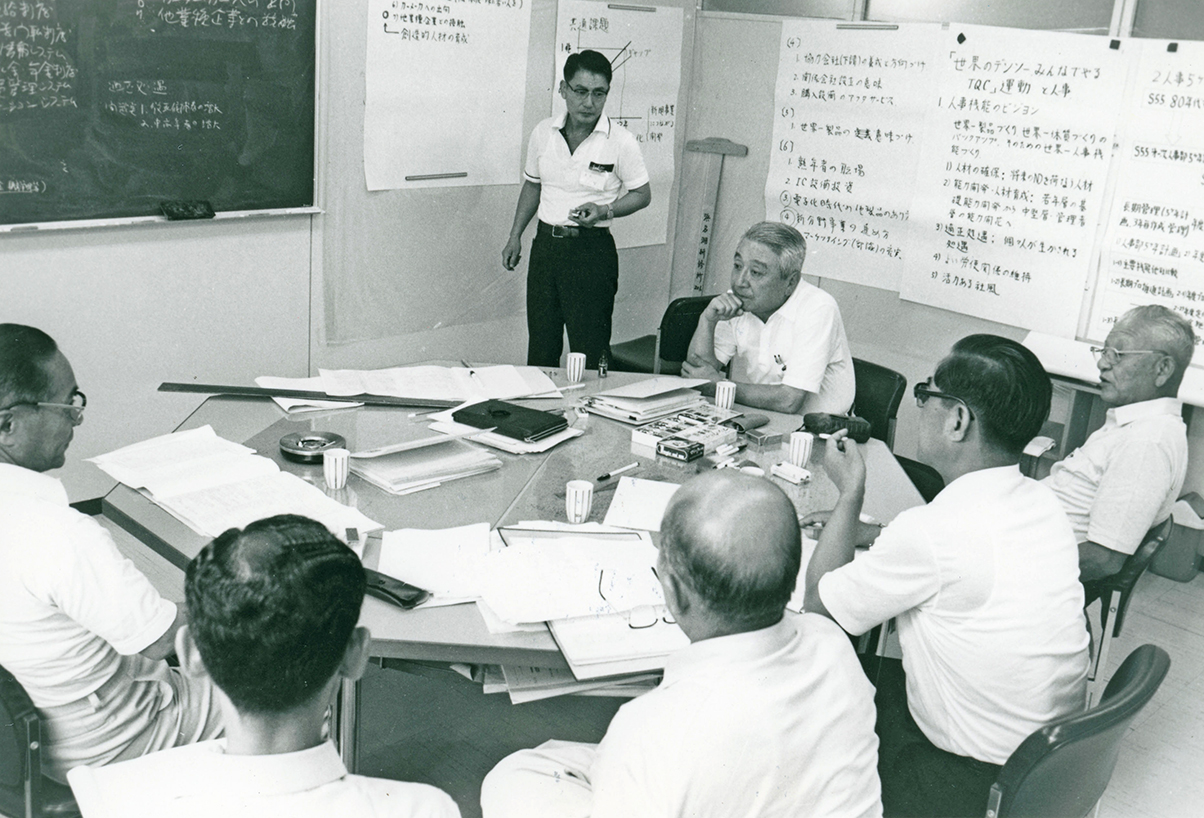
When formulating these guidelines, our company realized that we needed to approach the situation with a different mindset than before. We had to achieve greater results in strengthening our corporate structure and required more immediate and effective measures that fit the current reality. Therefore, we utilized the Total Quality Control (TQC) method. At that time, TQC activities were being vigorously promoted company-wide. During these activities, various issues were pointed out from a field perspective, and solutions were also proposed.
Prior to the formulation of the new guidelines, President Toda implemented the “Executive and Director TQC Training” in 1983. This was the first attempt where executives and directors unearthed company-wide issues from a management perspective, discussed the direction of responses collectively, and took the initiative in solving these problems.
During that year's Executive and Director TQC Training, we intensively discussed the challenges and countermeasures for securing sales using QC concepts and methods. Many of the ideas generated here became important foundations for the new guidelines. Furthermore, the candid discussions significantly strengthened the cohesion among executives and directors, accelerating the implementation of initiatives related to the new DENSO Principles.
- Deep DiveEstablishment of Executive and Director TQC Training
- The effectiveness of this method was reaffirmed, and the Executive and Director TQC Training became an integral approach for discussing the company's management issues, raising awareness among executives, fostering unity, and setting the direction for management. Subsequently, the format evolved to include only executives, with the name changing to “Executive Discussion Session” or “Executive Roundtable,” among others. The implementation methods were continuously refined to align with the current management situation and objectives, and these sessions were held repeatedly.