1. Responding to Internationalization
1971-
(1) To become a Truly International Company
- 1971
- The liberalization of automotive capital, a significant concern, was officially decided. In response, our company formulated “DENSO Principles for Globalization.” This moment served as a pivotal opportunity for us to solidify our resolve to become a genuine international enterprise, treating the entire world as our operational stage.
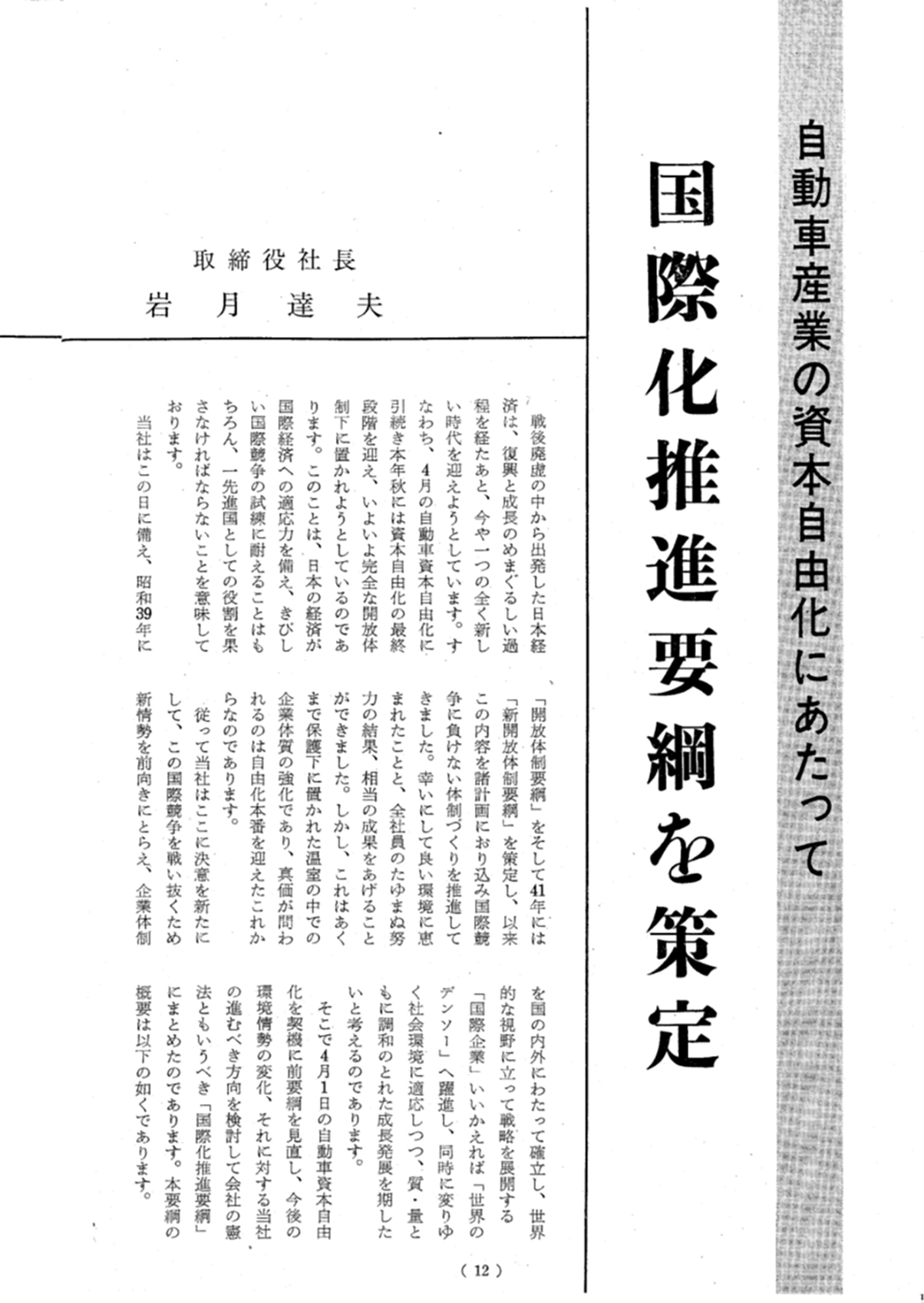
The “management by DENSO Principles” approach is a distinctive feature of our corporate governance. Facing the difficult challenge of trade liberalization, we developed our first DENSO Principles, “DENSO Principles for Open System,” in 1964. Following this, we formulated “New DENSO Principles for Open System,” using these as our rallying cry to collectively overcome the challenges associated with trade liberalization.
By the late 1960s, the movement towards economic liberalization was reaching its climax. In 1971, the decision to liberalize automotive capital was finalized. This meant that American and European car manufacturers would enter the Japanese market, and Japanese car manufacturers would have to compete directly with them. Our company, too, was compelled to create a business structure capable of producing competitive products to prevail in this environment.
In April 1971, we formulated “DENSO Principles for Globalization.” We declared our intent to become an “international company,” conducting business activities worldwide. Up until then, we had already been striving to build a system that could withstand international competition, achieving some degree of success. However, President Tatsuo Iwatsuki recognized that this success was largely due to the protection provided by government policies and regulations, akin to “strengthening our corporate structure within a greenhouse.” President Iwatsuki believed that the true test of our strength lay ahead.
The new DENSO Principles viewed the intensification of international competition not as a threat but as an opportunity. With renewed determination, we aimed to develop strategies from a global perspective. By becoming a “truly international company” capable of competing on the world stage, we sought to navigate the heightened domestic competition resulting from capital liberalization. This was the fundamental policy of President Iwatsuki.