4. Initiation of Planned Management
1949-
(1) The First Long-Term Plan
- 1954
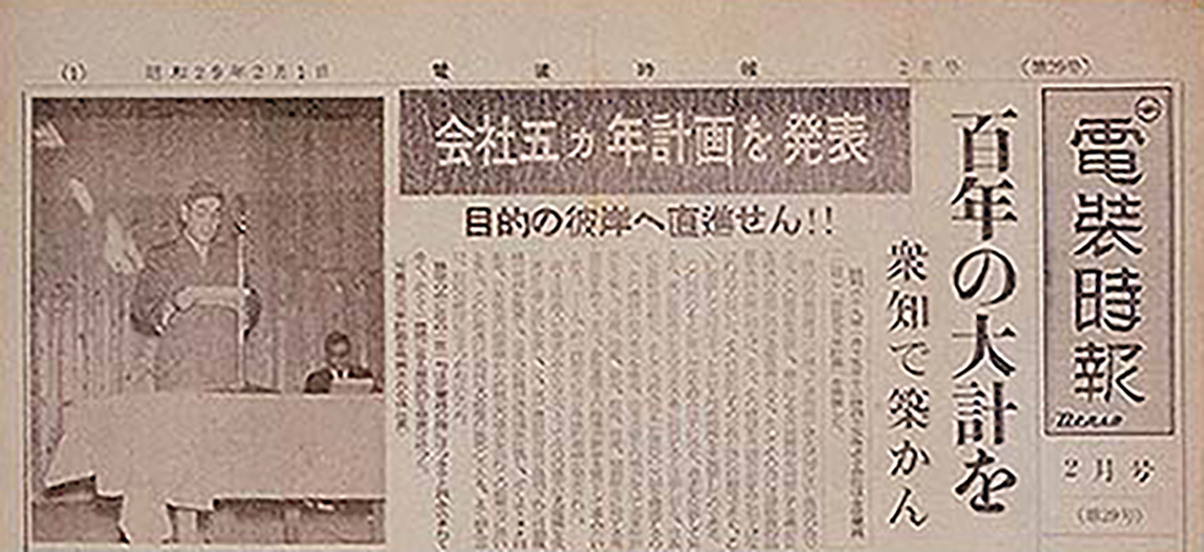
- To effectively implement the practical aspects of our collaboration with Bosch and to promote these initiatives systematically, we quickly applied the management techniques we learned from Bosch. This led to the formulation of our company's first long-term plan, known as the “First Five-Year Plan.”
While the technical partnership with Robert Bosch GmbH was established, it was imperative that this collaboration translated into tangible improvements in quality and cost reduction. To achieve this, our entire company needed to adopt a structured approach and methodically execute each necessary task.
The partnership with Bosch was set for a duration of 10 years, which we strategically divided into two phases. In the first five years, the goal was to absorb as much of Bosch's technology as possible. In the subsequent five years, we aimed to develop new products independently and devise and implement our own processing techniques.
To ensure the success of this plan, we decided to leverage the management methods we had learned from Bosch. This involved the creation and execution of a “management plan.” Thus, we embarked on drafting our first long-term plan.
In January 1954, President Torao Hayashi presented the drafted “Company Five-Year Plan” to approximately 900 employees. The slogan for this plan was ambitiously set as, “Let's stand shoulder to shoulder with Bosch within 10 years.”
Reference:Company Five-Year Plan
- Deep DiveMessage from President Hayashi (Company Five-Year Plan)
- Upon announcing the Company Five-Year Plan, President Hayashi addressed the employees with the following emphasis:
"The immediate and urgent task for our nation's economy is to increase exports and acquire foreign currency. To achieve this, we must first elevate our product quality to global standards, while simultaneously reducing our product prices to the levels of international competitors. Our focus on partnering with Bosch GmbH was rooted in this objective.
Reflecting on our past from this perspective, it becomes clear that Japanese corporate management has significantly lacked in planning. Therefore, our company has decided to establish a long-term plan and proceed under its guidance. To fully implement the Five-Year Plan and strengthen our management foundation, let us all unite and move forward as one."
However, as the five-year plan entered the implementation phase, the company was enveloped in a sense of tension. The plan encompassed a wide range of unfamiliar tasks, including quality improvement, expansion of the sales and service network, machinery upgrades, and cost savings. Additionally, we had to formulate production plans for each product, along with corresponding personnel, equipment, and financial plans. Everything was a process of trial and error.
- Deep DiveSignificance of the Company Five-Year Plan
- The early stages of implementing the Company Five-Year Plan provided invaluable experiences. Despite a challenging business environment, and a significant gap between targets and actual performance in terms of sales, workforce, and capital investments during the first two years, the plan proved to be a crucial learning period.
Given that this was our first long-term plan, developed through trial and error, numerous unforeseen problems arose. However, having a clear plan in place enabled us to address these issues to some extent. Although we faced many difficulties, this period became a valuable time for the entire company to learn the practical application of long-term planning, a feature that would come to define our management approach in the years to follow.
By 1956, the Ministry of International Trade and Industry (now the Ministry of Economy, Trade and Industry) announced the “Basic Plan for Rationalization of the Automotive Parts Industry.” This national policy aimed to strengthen the competitiveness of the automotive parts industry.
However, our company had already initiated its independent five-year plan ahead of this announcement. Therefore, in alignment with the ministry's guidelines, we revised our existing plan to reflect the economic downturn, while maintaining the original strategies. This revision reaffirmed our long-term plan as the “First Five-Year Plan.”