7. Responding to an Open System
1949-
(1) Introduction of the Division System
- 1963
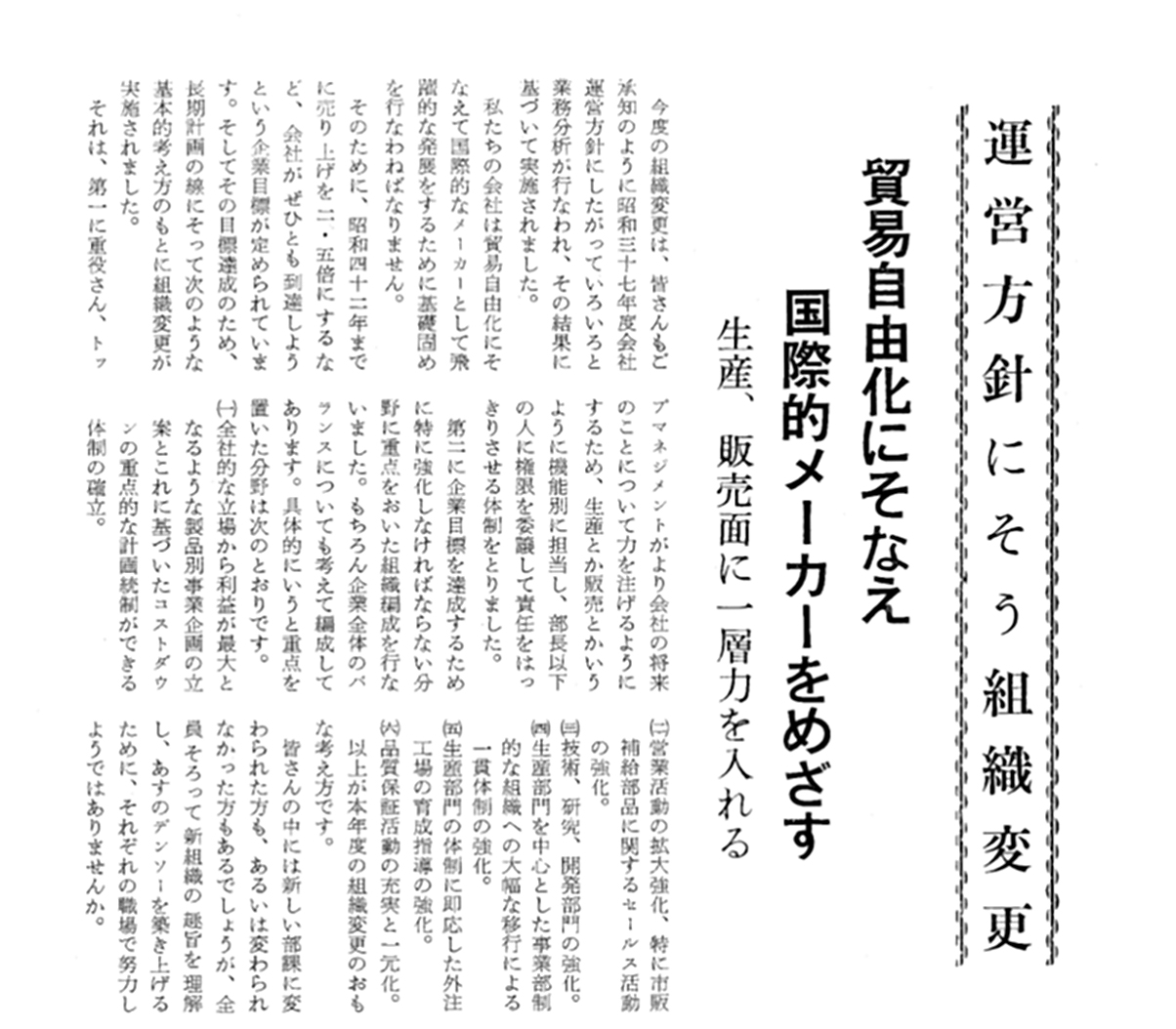
- In preparation for intensifying international competition, our company introduced the “Division System” in 1963, advancing the delegation of authority. This marked a significant shift in management from a “top-down centralized” model to a “decentralized” approach. More importantly, it also signified an internal mindset transformation.
In the 1960s, pressure from Western countries for Japan to liberalize its economy intensified. For the automotive industry, the liberalization of trade in both finished vehicles and parts was already challenging, but the anticipated subsequent liberalization of capital posed an even greater threat.
- Deep DiveThe Threat of Capital Liberalization
- In Europe, where capital liberalization had progressed ahead of Japan, the entry of the Big Three U.S. automakers quickly led to a reorganization and consolidation of the European automotive industry into European native capital and the European factories of the Big Three. Compared to European manufacturers, Japan's automotive industry was seen as vulnerable and unlikely to withstand such competition. Therefore, the Japanese automotive industry had no choice but to strive diligently to strengthen its capabilities. The words of Taizo Ishida, the president of Toyota Motor Corporation at the time, “Protect your own castle yourself,” became a shared understanding within the industry.
To survive in this environment, our company first needed to develop competitive new products through technological innovation that could stand up to Western standards. Additionally, it was necessary to develop highly efficient production facilities to realize these products.
To achieve this, we aimed to further enhance overall management efficiency, building upon the quality control system strengthened through our challenge for the Deming Prize. We decided to implement this through the introduction of “scientific management methods.” Specifically, we considered the “Division System,” which maximizes organizational capabilities through management by objectives, to be effective.
At that time, the Division System was a notable new management method adopted by many major companies in the United States, including GM, Ford, Chrysler, and GE, to develop their businesses. Our company introduced the “Division System” in 1963, establishing seven divisions based on major products. Each division was endowed with consistent functions from design to production and inspection, as well as the responsibility and authority to formulate long-term business plans.
Reference:Business Units at the Time of System Introduction
For our company, the introduction of the Division System was not merely an organizational overhaul or a shift to a trendy management method. It was a mindset reform for both management and employees, taking the form of organizational restructuring and delegation of authority.
For 14 years since our founding, President Torao Hayashi and the management team had exhibited outstanding leadership to overcome hardships and grow the business. However, with the expansion of our business scale, it became apparent that this alone would no longer suffice. By introducing the Division System, we made a bold decision to part ways with “top-down management.”
We expected employees at all levels to demonstrate leadership in their work with their own will and sense of responsibility, and to feel that they, too, were supporting the company's growth. Simultaneously, this reform aimed to provide all employees with significant chances for active participation.
- Deep DiveSignificance of Introducing the Division System
- Regarding the goals our company aimed to achieve through the introduction of the Division System, Tatsuo Iwatsuki, who led this initiative, stated the following:
“The era where only top management takes the initiative is over. Companies need a system in which all employees demonstrate responsibility towards their own work and the company, and from there, take initiative. In a management community, each employee, including the executives, moves in the same direction towards the same goal, which makes the potential very strong. The premise for this is a significant delegation of authority and division of responsibility, ensuring that even frontline employees can take action.”