7. Responding to an Open System
1949-
(2) Commencement of Management by DENSO Principles
- 1964
- Facing the daunting challenge of trade liberalization, our company formulated “DENSO Principles for Open System” as a management compass. Since then, we have established DENSO Principles at major turning points in our management.
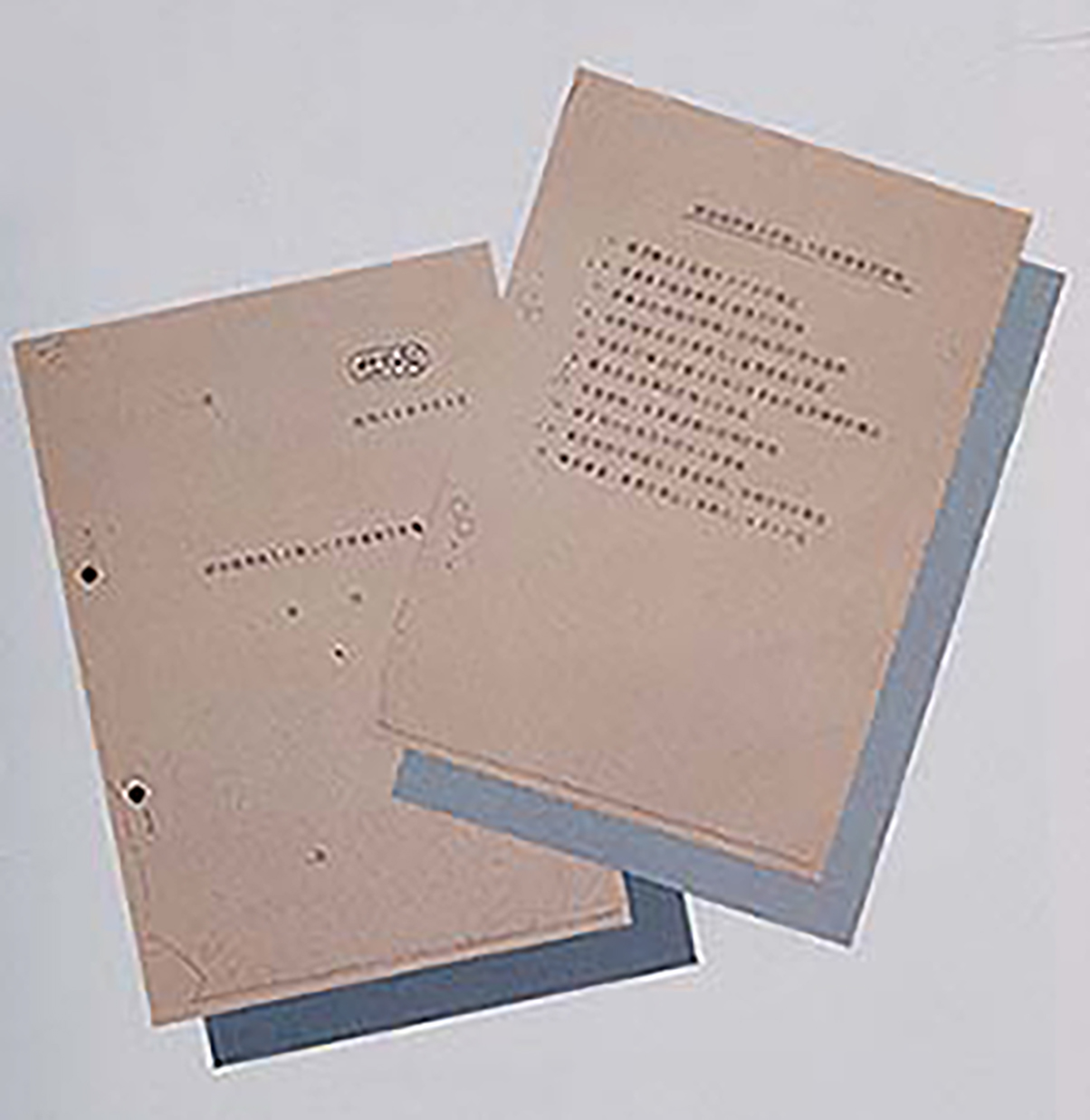
“Management by DENSO Principles” has become a distinctive feature of our company's management, continuing to this day.
At significant junctures and major changes in the business environment, our company has consistently formulated “DENSO Principles” (later renamed “visions” or “long-term policies”) to serve as a compass for management.
The first of these was “DENSO Principles for Open System.” Confronted with the unpredictable changes brought about by trade liberalization, our company resolved to mobilize all its resources to overcome the challenges. DENSO Principles articulated the direction, major strategies, and strong commitment of the company.
In 1964, Japan was set to transition to an IMF Article 8 country and join the OECD (Organization for Economic Co-operation and Development). This marked a significant step forward in the liberalization of the Japanese economy. The importation of automobiles and auto parts from overseas was expected to intensify, leading to unprecedented levels of competition both domestically and internationally.
How should we respond to this? Our company listened to and aggregated the opinions of managers, based on which we examined the measures to be taken. The results were compiled and announced in August 1964 as the “New Operational Policy for Entering the Open Economy” (later renamed “DENSO Principles for Open System”).
Reference:Overview of DENSO Principles for Open System
In this DENSO Principles, facing the major change of trade liberalization, we made a powerful declaration to our employees, which would be remembered within the company for a long time: “DENSO will become ‘Global DENSO.’ We will surpass Bosch and Lucas. We will strive towards this goal.”
At that time, we did not have any overseas bases, yet we made a declaration aiming for the global market. Regarding product development, while expressing gratitude to Robert Bosch GmbH, we declared our intention to “catch up with and surpass Bosch,” signaling an early commitment to independence and self-reliance. Our company began to clearly demonstrate a bold stance of moving away from dependence on technical alliances. This aspiration for independence and self-reliance would later become a fundamental principle in our management decisions at various critical junctures.
Following DENSO Principles for Open System, the liberalization of the automotive sector continued to advance. In October 1965, the “liberalization of passenger car imports” was decided. Even the government began to sense the crisis.
- Deep DiveGovernment's Sense of Crisis
- In October 1965, the liberalization of passenger car imports was decided, and the Japanese government's sense of crisis regarding the automotive parts industry intensified. As the country approached the scheduled capital liberalization in 1971, Japan's automotive parts industry was still quite fragile. To address this, the government aimed to elevate the industry to the level of the European automotive parts industry within five years. Consequently, in June 1966, the government revised and extended the “Temporary Measures Law for the Promotion of the Machinery Industry” (the third Machinery Promotion Law).
Amidst the increasingly stringent liberalization, there was a growing recognition within our company that “DENSO Principles for Open System” might no longer be sufficient to survive. When this realization set in, our response was swift. We immediately decided to revise the guidelines to suit the new environment. As a revised guideline, we formulated “New DENSO Principles for Open System” in September 1966.
Reference:Overview of New DENSO Principles for Open System
While inheriting the major policy from the previous guidelines of aiming to become a “comprehensive manufacturer of automotive parts that can defeat Bosch and Lucas,” the new guidelines added the ambition to “strengthen the corporate structure to the extent that we can expand and develop into non-automotive fields in the future.” Our company broadened its perspective to include expansion into non-automotive sectors.
Subsequently, whenever faced with significant changes in the business environment, our company formulated DENSO Principles as a compass for management. Regardless of the difficulty of the situation, each DENSO Principles invariably included a “positive stance and aggressive measures,” rather than merely focusing on defense. This proactive and forward-looking approach is a distinctive feature of our corporate management.