3. Establishment of Manufacturing Practices
1971-
(5) New Production Method
- 1971
- In response to the era of low growth, our company adopted the “Toyota Production System” (TPS) in 1971, building on our ongoing improvements in production sites. Initially, we faced challenges, but we eventually devised and promoted activities tailored to our company's characteristics.
Our fundamental approach to improving production sites was based on “IE (Industrial Engineering) activities.” Since our founding, we have promoted productivity improvement through activities such as standard labor management based on IE methods.
Observing Robert Bosch GmbH's success in productivity improvement using the “MTM (Methods Time Measurement)” standard time-setting method, we adopted MTM in the early 1960s. The number of officially certified MTM practitioners in our company exceeded 200, making us the leader in Japan. These experts also played a pivotal role in the introduction of the Toyota Production System.
During the period of rapid economic growth, our productivity improvement activities that combined IE and MTM focused on mass production through automation and in-line work improvements. However, the situation changed dramatically with the 1971 dollar shock, ushering in an era of low growth. Adapting to this new environment required a swift shift from mass production to waste-free manufacturing. Consequently, we decided to introduce the Toyota Production System in 1971.
- Deep DiveFeatures of the Toyota Production System
- The Toyota Production System (TPS) is built on two fundamental principles:
- Jidoka (Autonomation): This involves stopping the production line when an abnormality occurs to prevent the production of defective products.
- Just-In-Time (JIT): This principle focuses on producing only what is needed, when it is needed, and in the amount needed.
The TPS aims to eliminate waste comprehensively from the production line. It supports flexible production lines that can handle small lots and adapt to fluctuations in production volume. The system also pursues thorough inventory reduction and waste-free manufacturing.
TPS involves visualizing the entire flow of materials from the factory's entry to its exit and identifying the gaps between the ideal state and the current reality. These gaps are considered problems that need to be addressed through continuous improvement activities, striving to bring the actual state closer to the ideal.
- Deep DiveCharacteristics of Our High-Speed Automation Lines
- As a component manufacturer, our company developed high-speed automation lines to lower costs by producing quickly and in large volumes. Unlike the Just-In-Time production system, which focuses on producing only what is needed when it is needed and in the amount needed, our production approach required maintaining inventory to adapt to changes in the environment, such as fluctuations in order volumes.
The introduction of the Toyota Production System, which emphasizes “producing only what is needed, when it is needed, and in the amount needed,” called for a fundamental reform of our manufacturing process. Workers first needed a change in mindset, and the method involved teaching them to thoroughly complete tasks to their satisfaction. Even quick learners required several months to fully grasp this approach.
- Deep DiveDeployment of the Toyota Production System
- The Toyota Production System (TPS) expanded under the guidance of Toyota Motor Corporation and was adopted by various companies within the Toyota Group. In 1977, the “Toyota Production System Study Group” was established, comprising 25 companies within the group.
The purpose of this study group was to facilitate mutual learning on how to deploy and implement TPS, as the system required a considerable training period and the approach varied between companies. To maximize the benefits of TPS, cooperation across the entire production group was necessary.
In parallel, in 1978, our company launched its own autonomous study group, “T-Ken,” to promote the introduction of TPS into each manufacturing department.
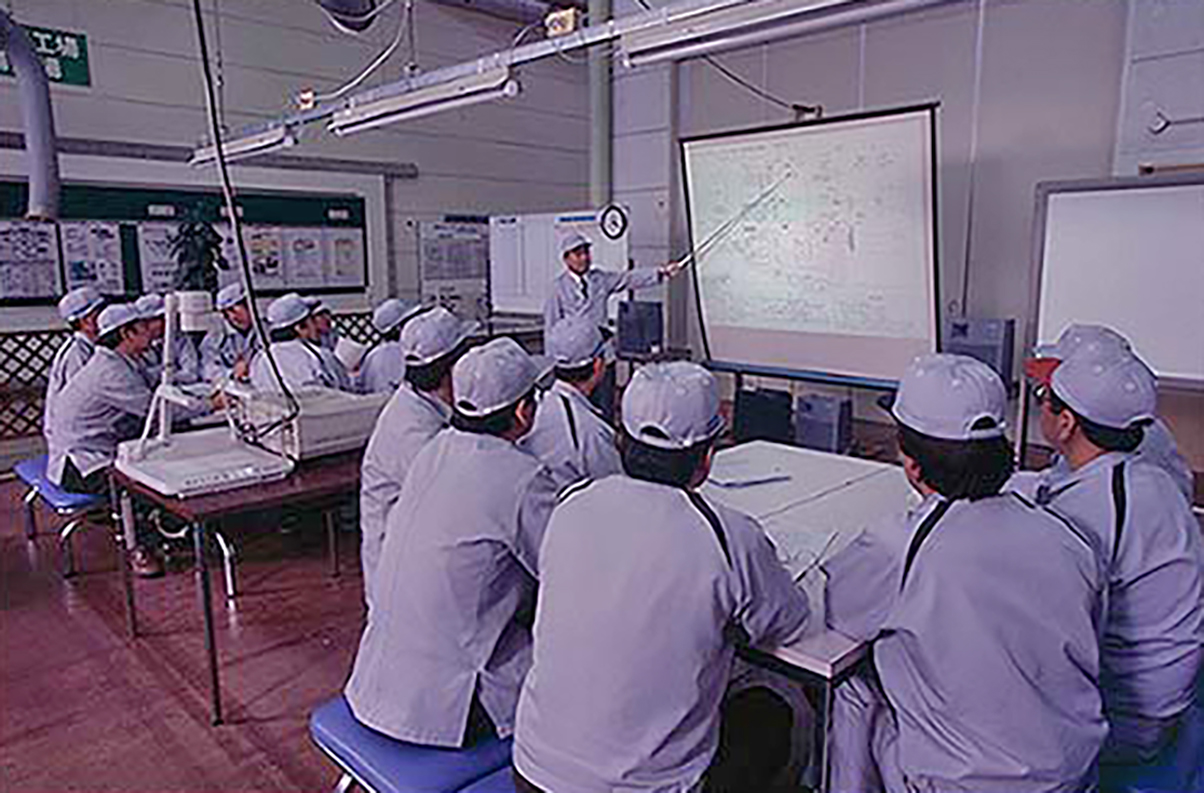
The deployment, penetration, and establishment of the Toyota Production System required strong and resilient production sites. Comprehensive IE improvement activities involving all employees were necessary.
In 1981, we expanded the IE activities we had cultivated into “TIE (Total Industrial Engineering),” extending them beyond direct departments to include management and indirect departments. This facilitated further penetration of the Toyota Production System. To ensure the establishment of TIE activities, we set up TIE organizations within each manufacturing department, promoting information sharing and problem-solving.
In 1984, we began guiding the introduction of TIE to our group companies. With the expansion of overseas production in the 1990s, we conducted training in various regions abroad, gradually extending the introduction of TIE to overseas production sites.
While TIE activities expanded and penetrated, they were staff-led activities. Changes in personnel, products, and production volumes often disrupted these activities, necessitating repeated rebuilding. Additionally, there was a growing emphasis on shortening product cycles and development periods, compelling manufacturing sites to enhance their adaptability.
This highlighted the need to shift improvement activities to be site-led. In response to this awareness, we launched the “EF (Efficient Factory) activities” in 1997. These activities were centered around factory managers at the forefront of manufacturing sites. By having workers themselves review their work processes, they could eliminate waste. EF activities were promoted as “efficient factory-building with total participation.”
Later, EF activities were renamed “Excellent Factory activities.” The new activities focused on strengthening the linkage between site improvements and technology. Furthermore, the scope was expanded to include the supply chain, making it a broad-based activity supporting our manufacturing.