


Information Disclosure Based on the Taskforce on Nature-related Financial Disclosures(TNFD)
DENSO has contributed to ecosystem conservation through initiatives aimed at addressing climate change, preventing environmental pollution and resource depletion, and promoting resource recycling. In addition, our employees have collaborated with local communities to advance activities such as preserving and restoring ecosystems in the areas around our business sites and protecting endangered species.
Recently, in addition to climate change, there are rising global concerns regarding the loss of biodiversity. The loss of biodiversity ties in directly with the degradation of natural capital and therefore has a major impact on our corporate activities.
Accordingly, we believe it is essential that we accurately assess the relationship between biodiversity and our business activities and enact measures, when necessary, if we are to enhance the stability of these activities.
To that end, we have recently been utilizing the Taskforce on Nature-related Financial Disclosures (TNFD), an international framework for the disclosure of biodiversity-related information, to carry out a trial analysis of our dependence and impact on nature and identify relevant risks and opportunities. In this section, we report the latest progress we are making in this endeavor.
Governance
Important items regarding our dependence and impact on nature and the relevant risks and opportunities are being deliberated on by the Companywide Safety, Health, and Environment Committee. This committee monitors and supervises the progress made toward qualitative and quantitative targets regarding our response to nature-related issues and evaluates business opportunities and risks. In this way, the committee will engage in decision-making based on comprehensive assessments
Strategy
Centered on the Safety, Health & Environment Division, we conducted an analysis in collaboration with external experts. This analysis was carried out with a high level of objectivity, utilizing the LEAP approach*3 stipulated by the TNFD as well as analysis tools such as Aqueduct provided by the World Resources Institute and the Integrated Biodiversity Assessment Tool developed by the International Union for Conservation of Nature in collaboration with other organizations. The analysis focused on a long-term timeframe, around 20 years in the future.
The results of the current analysis are as indicated below. Moving forward, we will continue to conduct analyses and reflect their results in our policies and plans for environmental activities.
*3 The LEAP approach is a recommended set of steps by the TNFD for TNFD based information disclosures. It involves four steps: Locate (interface with nature), Evaluate (dependencies & impacts), Assess (material risks & opportunities), and Prepare (respond & report).
Direct Operations
We conducted an analysis of production sites and found that, among the countries and regions where we operate, Japan has the greatest exposure to biodiversity loss risks, making it the highest priority region. The following shows the results of our analysis of major sites by country, taking biodiversity loss risks into account.
| Representative countries and regions of operation | Japan | Mexico | Hungary | China | India |
|---|---|---|---|---|---|
| IUCN Red List | 2,120 | 999 | 1,000 | 797 | 777 |
| Protected Planet(PA) *4 | 134 | 12 | 55 | 0 | 0 |
| Key Biodiversity Area (KBA) *5 | 11 | 2 | 9 | 4 | 6 |
*4
Areas designated for the protection of specific species and their habitats, registered in the World Database on Protected Areas operated by the UNEP World Conservation Monitoring Centre (UNEP-WCMC), a joint project of the United Nations Environment Programme (UNEP) and the International Union for Conservation of Nature (IUCN)
*5
Areas identified and registered worldwide based on criteria established by the IUCN, where species at risk of extinction or species dependent on specific habitats live
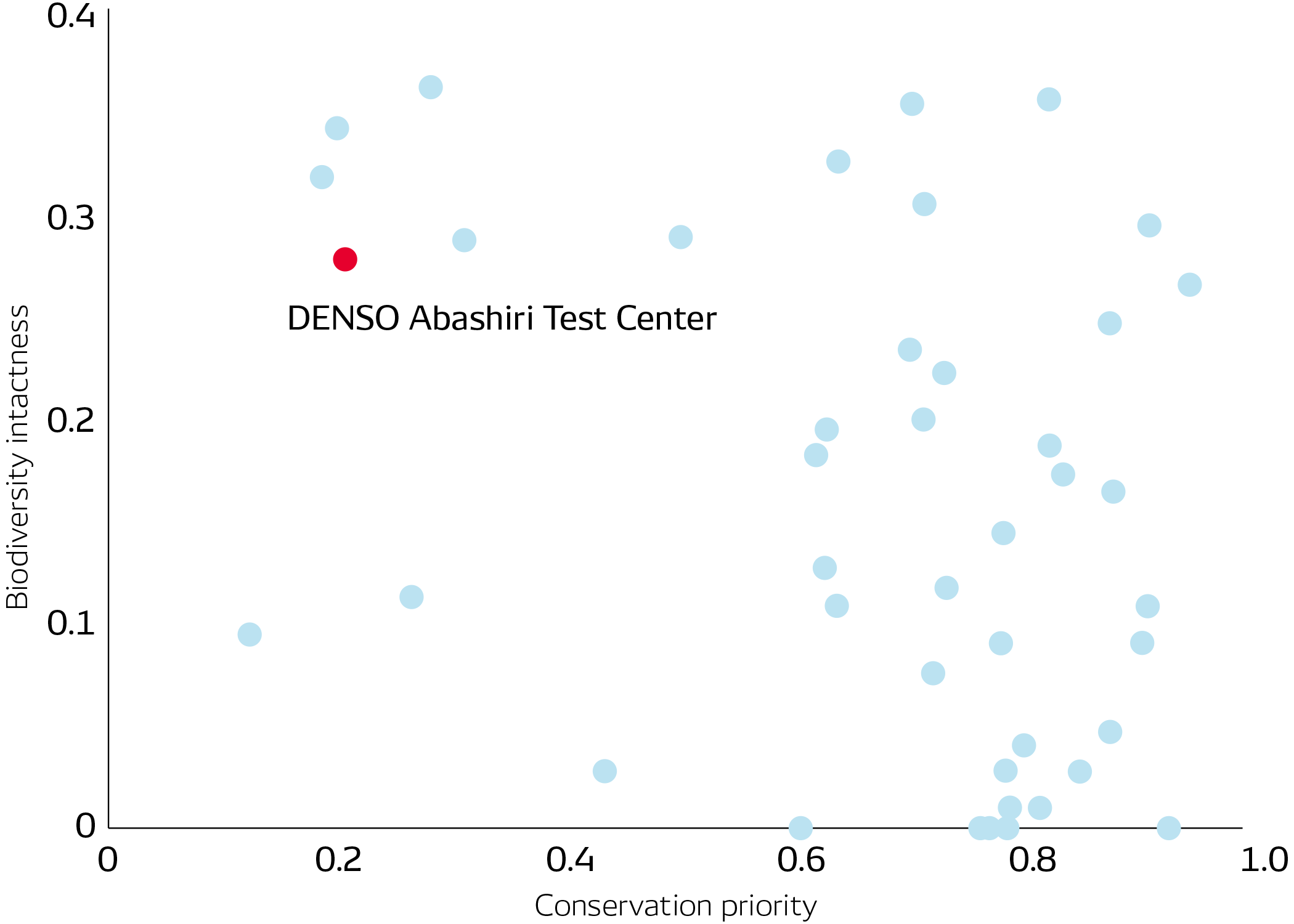
Accordingly, for production sites in Japan, we used ThinkNature’s *6 analysis tool, GBNAT (Global Biodiversity and Nature Assessment Tool), to focus on sites identified through data analysis as having high conservation priority, and among those, we decided to prioritize ecosystem monitoring and conservation at sites with high ecosystem intactness. Specifically, we are working toward registering the DENSO Abashiri Test Center, which has a large land area that contributes to ecosystem conservation and relatively high intactness, under the 30by30 OECM *7 initiative promoted by the United Nations. As a first step, we obtained certification as a Nature Symbiosis Site from Japan’s Ministry of the Environment, during which we established monitoring methods that satisfy part of the certification standards. Looking ahead, we will apply this methodology to sites with high conservation priority.
*6
A company that is addressing the challenge of sustaining the benefits of biodiversity and natural capital by visualizing the value of nature through natural capital big data and AI
*7
30by30 OECM: A United Nations initiative to conserve over 30% of terrestrial and marine areas as healthy ecosystems by 2030
-
Biodiversity Analysis of Production Sites in Japan*8
-
-
*8 Conservation priority
A quantified value that comparatively evaluates the priority of each location in reducing species extinction risk. The higher the value, the higher the extinction risk and the greater the importance of ecosystem conservationBiodiversity intactness
A quantified value measuring the degree of ecosystem modification due to land use. The higher the value, the more the ecosystem is preserved in its natural state (greater natural environment remaining)
Value Chain
In the upstream of our value chain, we believe the risk of biodiversity loss is high, especially at our overseas suppliers of raw materials. Accordingly, we conducted an analysis and evaluation of mining sites for bauxite, which is a raw material for aluminum used in such representative products as inverters and HVAC systems. The results of this analysis and evaluation are as follows.
-
Analysis and Evaluation of Risks and Opportunities Related to Mining Locations for Raw Material Bauxite
-

Management of Risks and Impacts
The risks identified in the analysis and evaluation will be reported to the Companywide Safety, Health, and Environment Committee, which will discuss such matters as relevant response policies and action plans. For risks that were determined to be particularly important, the Risk Management Meeting will invest resources into measures to manage such key risks.
Measurement Indicators and Targets
With a view to contributing to a nature-positive*9 global society, we have incorporated “biodiversity” into our upcoming Eco Vision. Furthermore, from among the 23 global biodiversity targets for 2030 outlined by the United Nations, we have integrated three specific targets into our Environmental Action Plan—Target 3: Conserve and effectively manage at least 30% of protected areas and other effective area-based conservation measures by 2030; Target 11: Restore, maintain, and enhance nature’s contributions to people; and Target 12: Secure green and blue spaces in urban areas. Moving forward, we will define specific indicators and continue advancing our Environmental Management System (EMS).
*9 Nature positive: The concept of stopping biodiversity loss and shifting toward a path for recovery
TOPIC : DENSO Abashiri Test Center Certified as a Nature Symbiosis Site by the Ministry of the Environment and Registered in the International Database