


Sustainability Management
DENSO’s Sustainability Management
DENSO’s sustainability management involves incorporating the perspective of social sustainability within the Company’s management strategies in order to improve corporate value. In other words, sustainability management means that we contribute to the resolution of social issues through our businesses.
The spirit of our sustainability management is encapsulated in the phrase “Provide quality products and services,” an essential part of the DENSO Creed, and this approach represents the core of our management that we have inherited since our founding and provides us with the driving force for growth.
History of Our Sustainability Management
Automobiles have always had positive and negative aspects. On the one hand, they provide a safe and comfortable means of transportation. On the other hand, they adversely impact society in such ways as exhaust gas and traffic accidents. Since its inception, DENSO has always tackled social issues head on using an approach that involves maximizing the positive aspects of automobiles and minimizing the negative ones. By doing so, DENSO has realized growth by striving to make cars more eco-friendly, safer, and more comfortable and convenient.
The creation of the electric car “DENSO-GO” at the time of the Company’s founding, when our management faced various hardships, was an undertaking that embodies our ambition to make cars better. From the 1970s on, we have created employment opportunities and contributed to the development of local communities by promoting Monozukuri and Hitozukuri at our manufacturing bases around the world.
In addition, we have extended the technologies that we have cultivated for the automotive industry to the fields of factory automation (FA) and agriculture, thereby working to address new social issues such as labor and food shortages.
In these ways, we have been constantly implementing sustainability management that balances business growth with the resolution of social issues. We therefore consider sustainability to be a part of our DNA itself.
Sustainability Policy
We formulated the DENSO Group Sustainability Policy to ensure that all Group employees engage in actions that adhere to the DENSO Creed and our basic Philosophy, and that are befitting of a global company, amid their interactions with society and our stakeholders. This policy reflects our commitment to taking action and is endorsed by the president & CEO of DENSO CORPORATION and the presidents of all Group companies in Japan and overseas.
Promotion Structure
With the executive in charge of the Corporate Strategy Center serving as overall leader, the Corporate Strategy Division oversees Companywide sustainability management functions. We have established the Sustainability Meeting as a forum for Companywide discussion on the direction of sustainability management for the DENSO Group. The Sustainability Meeting is responsible for advancing sustainability management by identifying opportunities and risks, deliberating on proposed Materiality, and monitoring and adjusting activities. The matters discussed are then submitted to the Board of Directors.
To foster awareness among employees, who are key players in advancing sustainability management, DENSO incorporates into annual individual goals a process that visualizes how each employee’s work is connected to addressing social issues.
Also, to promote understanding and entrench a culture of sustainability as well as to disseminate related information, each DENSO CORPORATION division, domestic Group company, and overseas regional headquarters appoints one sustainability leader, who is tasked with ensuring the penetration of a culture of sustainability throughout all workplaces.
Sustainability Structure

| Chairperson | Executive Vice President |
|---|---|
| Composition |
Each Materiality promotion officer (executive level) Note: Heads of business groups and regions also attend when coordination across businesses or regions is required. |
| Purpose |
|
| Meeting frequency | Twice a year |
Materiality
To constantly implement sustainability management, we incorporate social issues into DENSO’s Long-term Policy for 2030 and our material issues (Materiality), and work to resolve them through our business activities.
In the Long-term Policy for 2030, we have identified “green,” “peace of mind,” and “inspiring” as the areas in which we can contribute through our business.
From among the social issues related to these areas, we identify as our Materiality those themes that are of high importance to the realization of a sustainable society and to which DENSO should contribute. For each theme, we establish targets and advance initiatives toward their achievement.
Specific activities – Activities to permeate Sustainability
Implementing sustainability management means that all divisions and employees consider how they can contribute to the resolution of social issues in their day-to-day work and take action to do so. Accordingly, we believe that sustainability management is the first step toward resolving social issues.
In light of this belief, we consider and promote a broad range of initiatives, such as activities to effectively raise awareness of sustainability among employees and communicate information, to ensure that each employee can speak about sustainability management in his or her own way and engage in appropriate actions. These initiatives are promoted in consideration of cultures in each area of operation and the corporate cultures of each Group company.
Also, to make sure that we convey how our efforts relate to society in an easy-to-understand manner for all of our stakeholders, including our employees, we are actively disseminating information and engaging in communication leveraging the SDGs, which have become a globally shared language.
-

Educational tours (the EU)
-

In-house newsletters (Kyosan Denki Co., Ltd.)
-

e-learning (Asia)
-

Workshops (China)
[Topics] My Efforts toward the SDGs
-
-
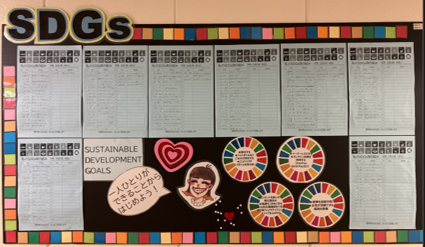
At the Kota Plant, we have been working to promote employee understanding of sustainability management at a workplace level through efforts such as the Outstanding People Caravan, an event where department heads, plant managers, and sustainability leaders come together to share examples of personal actions toward the SDGs. Over 350 members of the plant’s semiconductor manufacturing division have participated in this event, recording their goals regarding how they would like to contribute to the sustainability of society through their own work and actions under the theme “My Efforts toward the SDGs.” These goals are displayed throughout the plant. In this way, the Outstanding People Caravan provides opportunities for employees to not only reflect on their own actions but also make new realizations by learning the declarations of their colleagues in the workplace.
*An initiative to showcase SDGs One Action best practices presented by department heads, plant managers, and sustainability leaders across all divisions.
Initiatives of DENSO CORPORATION
Employee awareness
To approach sustainability from a multifaceted perspective and to understand how our work relates to social issues and pursue efforts accordingly, we held meetings provided by outside lecturers (investors, officers in charge of sustainability at corporations, and members of international organizations) and workshops that helped deepen the understanding of sustainability among our employees.
-
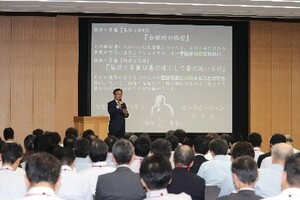
Meeting with outside lecturer
Incorporating Sustainability into Fiscal Year Plans
When formulating annual plans, divisions are asked to utilize the SDGs along with a perspective of addressing social issues to formulate individual employee performance goals based on the role of their organization and their priority initiative themes for the given fiscal year. This approach is taken to deepen the understanding of sustainability among all divisions and all employees.
[Topics] Indication of Relevant SDGs on Employee IDs (DENSO CORPORATION, Group companies in South Korea, and other Asian Countries)
-
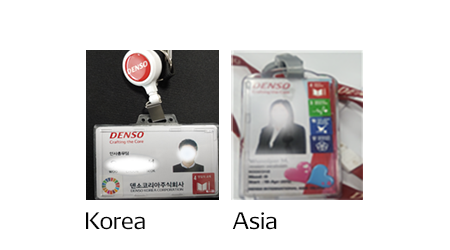
When setting personal annual performance goals, employees are asked to think about the SDG goals to which their work will contribute and to indicate those goals on their employee IDs and business cards. This measure allows employees to reflect on their own SDG goals and to share these goals with their colleagues and thereby create more frequent opportunities to talk about how to contribute to the accomplishment of the SDGs.
-
Communicating Information
We disclose information via integrated reports, our corporate website, news releases, and other media while also encouraging all employees to proactively discuss sustainability themes with customers, their families, and other stakeholders with the aim of communicating our initiatives to external stakeholders.
To achieve this aim, it is important that all employees understand our sustainability business strategies.
Accordingly, videos and other materials featuring introductions of our strategies toward the “green” and “peace of mind” by management are posted on the in-house intranet in an effort to deepen employee understanding.
Understanding the Level of Sustainability Awareness among Employees
We conduct an awareness survey to ascertain and check the level of understanding and implementation of sustainability by employees.
【Case Study】Sustainability Survey
DENSO Corporation has held the "Sustainability Survey" annually since 2006 to assess and check the degree of understanding and implementation of sustainability among employees.
Results of fiscal 2025 survey (approx. 1,700 correspondents)
Question 1: Do you understand how your work contributes to the accomplishment of the SDGs?

Since fiscal 2020, DENSO CORPORATION has been implementing initiatives that require employees to identify which SDGs their work contributes to when determining their individual goals for the fiscal year. These initiatives aim to deepen employees’ understanding of the connection between their work and the SDGs. Over the years, however, the time spent in discussions between employees and their supervisors regarding these goals during meetings and other settings has decreased. Going forward, as a priority initiative, DENSO will promote awareness-raising activities focused on its material issues with the aim of helping employees better understand the relationship between their work and these material issues.
Question 2: Choose the option(s) that best matches your thoughts regarding sustainability and the SDGs.

Dialogue with Society

The DENSO Group’s Stakeholders
DENSO values dialogues with stakeholders to avoid self-righteous activities adhering only to Company logic and assumptions.